
Start an Alpena County Property Search
The fastest route into Alpena County property records is the county BS&A portal. It runs separate searches for assessing, property sales, current taxes, delinquent taxes, and detailed records. An address or parcel query usually pins down the administrative parcel first. For owners, search the surname alone. Note the exact hyphenated parcel number. Carry that number and the displayed name into the deed and tax layers.
Trust a match only after two keys agree. Street names change, owners may use initials or entity names. Parcels split. A legal description often outlives a mailing address. A result screen is an index, not a survey, and never proof of clear title.
- Search BS&A by address, surname, or full parcel number.
- Save the parcel key, record year, and legal-description clues.
- Check the Register of Deeds index for the recorded instrument and grantee.
- Open tax and delinquency views for their distinct years and status.
- Request certified copies or older files from the correct custodian.
Alpena County Property Record Keepers
Three offices hold the core Alpena County property records. The Register of Deeds records instruments that transfer, encumber, release, or describe land. Equalization backs assessment, GIS, and taxable-value work. The Treasurer covers delinquent real-property taxes, settlement, reversion, and foreclosure routes. All three sit in the county building on West Chisholm Street. Their files are not interchangeable.
Alpena County Register of Deeds
720 W Chisholm Street, Suite 4
Alpena, MI 49707
989-354-9547
Alpena County Equalization
720 W Chisholm Street, Suite 5
Alpena, MI 49707
989-354-9560
Alpena County Treasurer
720 W Chisholm Street, Suite 3
Alpena, MI 49707
989-354-9534
Alpena County BS&A Layers
The county portal keeps five separate lanes: assessing, property sales, current taxes, delinquent taxes, and detailed records. Property Information covers 2025, Tax Information covers 2024, and delinquent taxes get their own area. Every value needs its year. Public previews may also stop at an access notice. Never mistake the screen for the full county file. The Alpena County BS&A service list shows the lanes before a search begins.
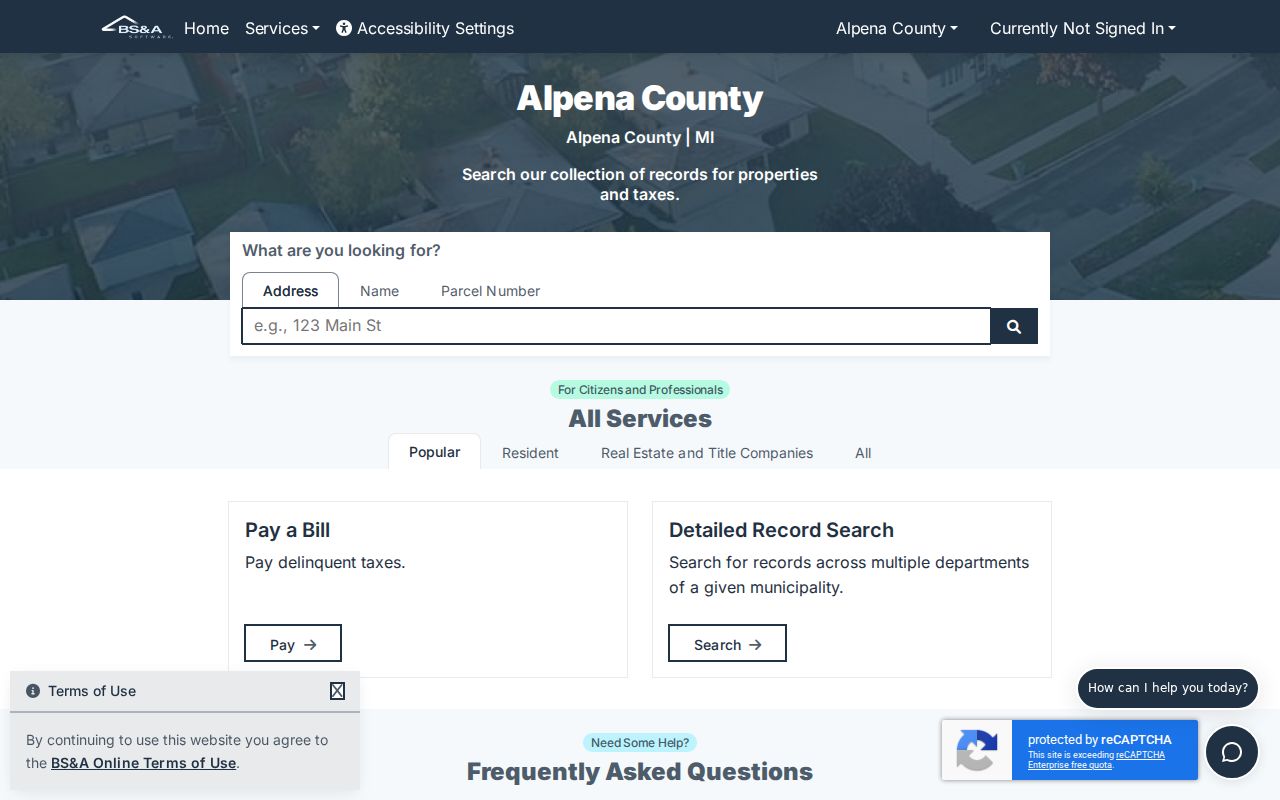
The capture makes the split between assessment, sale, tax, delinquency, and payment services clear.
Alpena County Deed Search Routes
The Register of Deeds steers limited public searches to Tapestry and regular search work to Laredo. The office publishes no earliest online year or full field list. Search grantor and grantee spellings both. Keep the recording date and instrument type. Follow the prior-deed reference when one appears. At the counter, staff maintain indexes and reception books. A grantor/grantee register search costs 50 cents per year with a $5 minimum. Deeper history may call for deed books, library material, or the Archives of Michigan rather than any assumed web cutoff.
Recorded Alpena County Instruments
Recorded land records cover deeds, mortgages, land contracts, liens, assignments, discharges, surveys, corners, and plats. Originals must be signed and notarized. Changes happen by recording a new instrument. The office supplies no blank deeds and no legal advice.
E-recording is accepted through 3:30 p.m., paper and walk-in filings through 4:00 p.m. Recording costs $30 per document. Copies are $1 per page, plat copies $3, and certification $5. Court-certified papers, death certificates, land corners, master deeds and amendments, and plats stay outside e-recording. The Register of Deeds entry page posts hours and access routes.
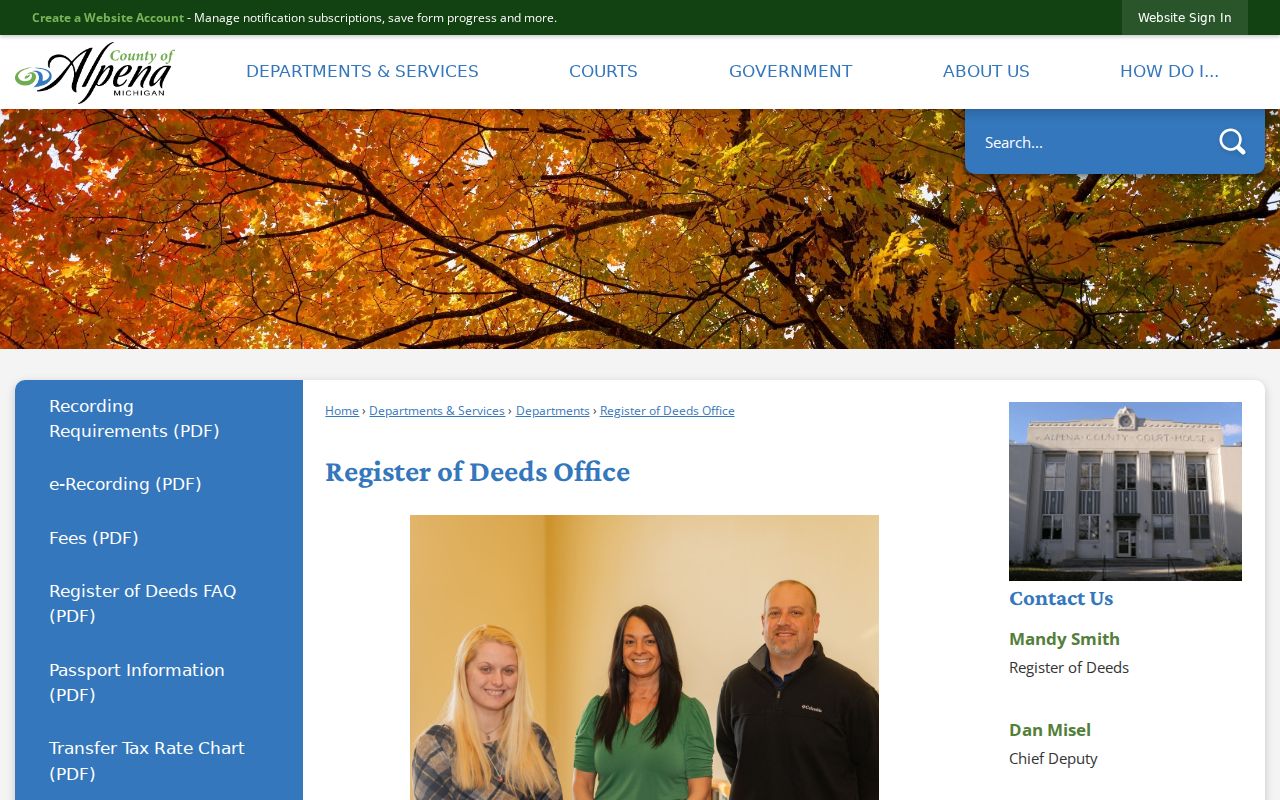
The capture places recording rules, search links, and the alert route together.
Alpena County Property Record Types
A parcel file is never one document. Deeds, assessment entries, tax rolls, and plats each carry a piece, joined by party name, date, parcel number, and legal description.
| Record Type | What It Documents | Kept By | Access |
|---|---|---|---|
| Deeds and contracts | Transfers and recorded interests | Register of Deeds | Tapestry, Laredo, counter |
| Mortgages and liens | Claims, assignments, releases | Register of Deeds | Index and copies |
| Assessment and tax | Owner display, values, tax status | Equalization, assessor, Treasurer | BS&A and requests |
| Plats and surveys | Lot, block, survey, corner context | Register of Deeds and OLSR | Search and copies |
| Permits and zoning | Land use and work history | Municipal authority | Portal or request |
Deeds prove recorded transfers. Assessment files carry the administrative owner and value fields. Tax files show current or delinquent status, plats give lot context, and permits and zoning belong to the city, village, or other authority with jurisdiction.
Read Alpena County Property Values
Michigan's value terms are not synonyms. Assessed value usually sits at 50 percent of true cash value. State equalized value reflects equalization. Taxable value is the capped base used for taxes until a transfer or another rule changes it. A sale price is evidence, not an automatic measure of true cash value.
A 2026 local report flagged possible missing additions and barns in some land-parcel assessments. County equalized value rose 9.2 percent. Taxable value rose 5.14 percent. Read the story as a prompt, not a correction. Verify parcel characteristics with Equalization or the local assessor.
Alpena County Parcel Scale
Alpena County's 2025 count lists 23,652 parcels: 21,450 real, 1,375 personal, and 827 exempt. The parcel number is the safer cross-system key. The county offers no public interactive GIS viewer. BS&A list results are a list, not a map.
Michigan assigns tax-parcel layers to counties, and the statewide layer is not an open public download. Equalization sells aerial and linework data at township and county scales. Tax lines are aids, not surveyed boundaries. Use recorded plats, surveys, and land-corner records instead.
Alpena County Jurisdiction Checks
A mailing address never settles jurisdiction in Alpena County. The same postal name can sit across two deed and tax systems. The ZIP code tells you nothing about which recorder or treasurer holds the file. Hillman splits between Alpena County and Montmorency County. A Hillman parcel number may belong to either. Posen, meanwhile, lies in Presque Isle County. City of Alpena parcels can also trigger separate city checks for zoning, permits, and utilities.
Before you trust any deed records, confirm the county, the municipality, the township, and the parcel number. Use the focused routes for Alpena property records and Hillman records once the county is settled.
Historic Alpena County Property Records
Alpena County began as Anamickee, laid off in 1840 and organized in 1857. Old property records often describe land by township and range rather than by street address. Historic descriptions in Alpena County fall within townships 29N through 32N and ranges 5E through 9E. The Archives of Michigan holds assessment rolls from 1858 to 1900 and 1931 to 1979. It also holds tax rolls from 1884 to 1970. Chancery tax foreclosures there run from 1889 to 1928.
The Alpena Public Library adds directories, maps, newspapers, diaries, and photographs. A county-government finding aid there covers 1869 to 1932. These are substitutes for the lost 1890 federal census. Directories, tax rolls, probate files, newspapers, and church or cemetery records can rebuild the context around an old parcel. Still, every clue must be matched to a recorded deed. It could also be matched to another controlling record before it counts.
Alpena County Delinquent Tax Records
Current and delinquent taxes live in separate systems. The Alpena County Treasurer handles delinquent real-property taxes, the March settlement, and tax reversion. The office also manages the revolving fund. The county delinquency page links hardship materials, foreclosure timing, a tax search, public land auctions, and payment options. It also posts notices about foreclosure-sale proceeds.
A payment screen is not proof of title. Record the parcel number and tax year. Then compare the party shown and the legal-description clues against the recorded deed records. If the online tax roll fails to load, contact the Treasurer directly. Do not guess at delinquent status.
Alpena County Fraud Alerts
The county offers a free Property Fraud Alert. It sends notice whenever a document is recorded under a monitored name in Alpena County. It does not stop recording, prove fraud, or replace a deed review. Treat it as an early signal. Inspect the instrument and call the Register of Deeds. The county alert page explains the county-only signup.
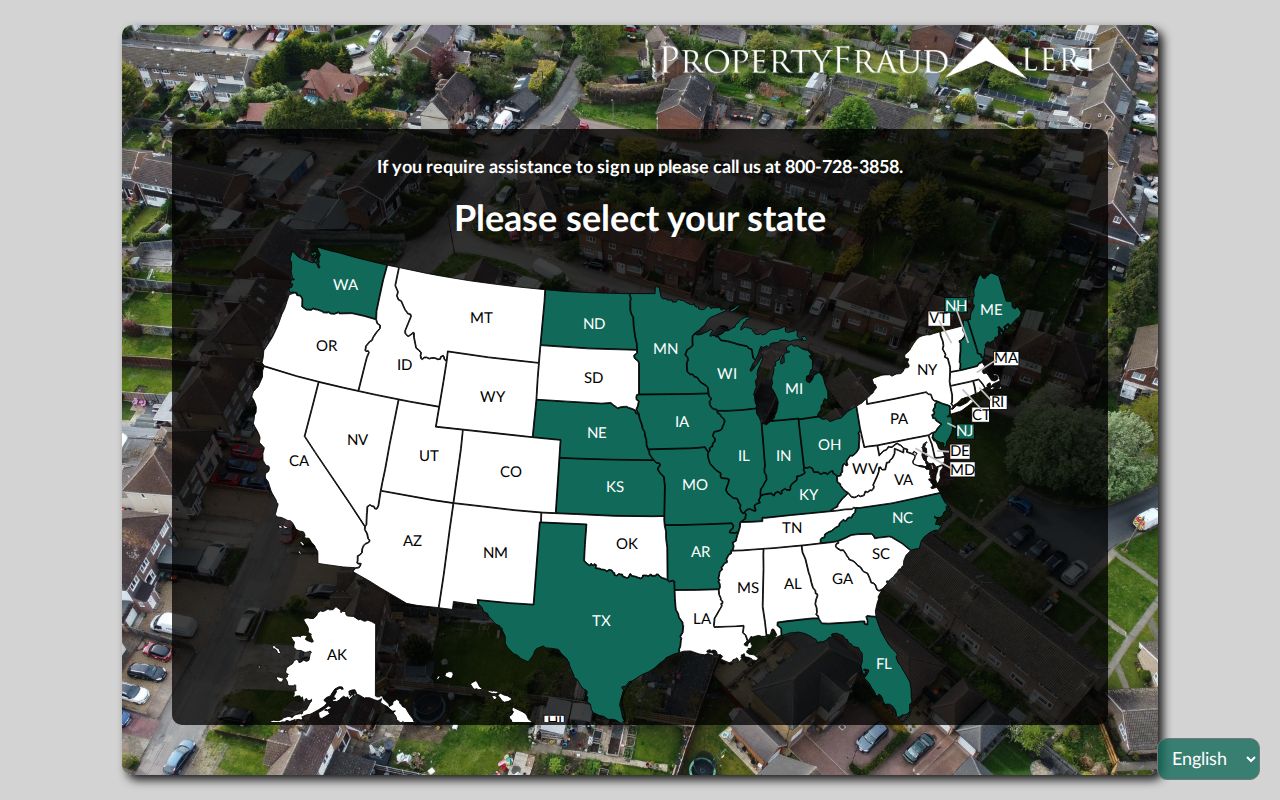
The capture shows the alert as a companion to regular deed monitoring.
Request Missing Alpena County Records
A dead end at a login screen, a blank result, or a missing year is not final. It just means a different channel works better. The Register of Deeds accepts in-person, mail, courier, and copy requests for deed records. Equalization fields assessment, GIS, and taxable-value questions. Delinquency belongs to the Treasurer. The Clerk handles circuit-record inspection, searches, and certified copies.
Alpena County takes FOIA requests by mail, fax, email, or hand delivery. Name the record and the responsible office. Email and fax requests count as received one business day later. The county then responds within five business days or issues a written ten-business-day extension. FOIA cannot override confidentiality or force an office to create a new record.
Alpena County Court Record Connections
Some property questions leave the land-record system entirely. A foreclosure suit, a judgment, probate, a divorce, or an estate proceeding can explain why an Alpena County deed names an unfamiliar party or grants someone authority. MiCOURT supplies an informational case lookup for the courts it covers, while the Alpena County Clerk maintains Circuit civil, criminal, and family records with public inspection, searches, and certified copies.
Start from the deed or tax record that points to the case. Save the party name, case number, date, and court. Then run the MiCOURT case search for a first match, or submit the Clerk's court-record request for the official file. A docket summary only lists events. It is not a certified order, and not every court event transfers title. Match any order back to the instrument recorded with the Register of Deeds before drawing conclusions about the owner of record.
Alpena County Legal Descriptions
A modern address helps you find land. But the recorded legal description controls how documents connect. Platted property in Alpena County may be described by subdivision, lot, and block. Rural land often uses section, township, and range. Some instruments rely on metes and bounds, survey calls, or references to an earlier deed. Copy the full text, including exceptions and easements. Do not shrink it to a street number.
Michigan's Accela OLSR portal offers a public recorded-plat search. The Register of Deeds keeps plats, surveys, and corners on file. Historic plat books can help orient an old place name. None of these alone stakes a boundary. When placement matters, set the recorded description beside current survey evidence and qualified field work. Check the GIS map for orientation rather than authority.
Limits of Alpena County Property Records
Public Alpena County property records can show plenty. They reveal a displayed owner, the recorded grantee, a parcel key, values, taxes, and liens. Plats, permits, and court events also appear. What they cannot do is prove who occupies a site. They cannot guarantee that every claim has been found. Nor can they fix a boundary on the ground, or state what land will sell for. A certified copy proves the contents of one record, not a complete title conclusion.
Lawful use. Alpena County property records support due diligence, boundary research, estate work, and civic transparency. Always keep the inquiry tied to a lawful property purpose. Never use owner data to stalk, harass, or harm a person.
Dates deserve close attention in any Alpena County property records search. A deed may be signed weeks before it is recorded. An assessment field can describe one tax year while a sale field reflects another. Court dockets list filings without always showing the certified final order. Note the date beside each fact. Also note whether it came from an index, an image, a staff response, or a certified copy. That trail keeps an old screen from being mistaken for current information.
Privacy rules shape the work too. Michigan voter records leave out protected fields. These include driver and identification numbers, birth month and day, phone, and email. Birth records carry eligibility limits. Courts can seal or restrict case material. The state's Address Confidentiality Program, under Act 301 of 2020, gives qualifying participants a designated address. It includes mail forwarding. A redaction or designated address must stay intact. Public availability never permits a searcher to defeat a login. It never permits rebuilding a protected address or assembling a sensitive personal dossier.
Ownership questions require separating four labels that look alike. The assessment owner is the name shown for an administrative year. The taxpayer is whoever receives the bill. The grantee is the party receiving an interest in a recorded instrument. The mailing addressee is simply where notices go. Alpena County property records do not guarantee these roles overlap. Compare the latest deed, parcel key, legal description, and record year before calling any name the confirmed owner.
Land-use facts need their own sources. The City of Alpena portal covers municipal property, utility, permit, planning, and zoning services. Hillman offers zoning forms and a local FOIA route but publishes no indexed permit database. A county assessment description does not prove work was permitted. A cached zoning label may trail a later ordinance. Match the parcel to the right city, village, or township office. Request the current municipal record when the public screen cannot answer the question.
Address history can change the route as well. A county ordinance assigns road names, parity, and numbering through a local grid. Older deeds and directories may still carry rural-route or former street wording. Search the present address first. Then try direction, suffix, unit, and historic-name variants. Keep the parcel number and legal description beside each version. That small record of name changes links a modern BS&A card to an older deed, plat, directory entry, or tax roll. It does so without assuming two similar addresses describe the same land.