
Inside Alpena County Tax Records
The tax side of Alpena County records divides cleanly between two offices. Assessment is one job. Collection is another. The Equalization Office links the county to its BS&A system and helps local assessors with assessed value, State Equalized Value, taxable value, classification, and GIS questions. The County Treasurer, by contrast, takes on delinquent real-property tax, settlement, reversion, and the delinquent tax revolving fund, so a current municipal bill and a delinquent county balance are two different records, never interchangeable.
| Field | What It Shows | Where |
|---|---|---|
| Assessed value | Generally one-half of true cash value | Local assessor and BS&A |
| State Equalized Value | Equalized assessed value for the year | Assessment record |
| Taxable value | The capped tax base used to calculate tax | Assessment and tax record |
| Current tax status | Tax-year charge and payment information | BS&A Current Tax Search |
| Delinquent status | Past-due tax, foreclosure, or payment route | Treasurer and Delinquent Tax Search |
True cash value is Michigan's fair-market idea. Assessed value and SEV generally sit at half. Taxable value is different. Proposal A caps it until a transfer resets the base. The millage applies to that taxable base, so the bill never states what a buyer would pay, and a recorded sale can help but remains a separate record with its own date and context.
Alpena County BS&A Tax Paths
The Alpena County BS&A portal sorts its searches into tiles. Assessing Search, Property Sale Search, Current Tax Search, Delinquent Tax Search, and Detailed Record Search each answer a different question. Pick the matching focus. One summary screen is never a complete tax history. Copy the heading and year label with every figure. Property information and tax information can carry different assessment years.
| Portal choice | Useful search key | Record purpose |
|---|---|---|
| Assessing Search | Address, name, parcel number | Assessment and parcel details |
| Property Sale Search | Parcel or sale criteria | Recorded sale context |
| Current Tax Search | Address or parcel | Current tax account |
| Delinquent Tax Search | Address or parcel | Past-due county tax |
The BS&A manual describes a simple workflow. A user picks a search focus, then searches by address, name, or parcel number. Advanced address or address-range controls may also appear. Some details sit behind paid access. Indexed pages carry a reference-only disclaimer as well, so rely on the tile names and visible year labels rather than assuming every year is online.
The county parcel preview shows how a detail-access notice can appear on an individual record.
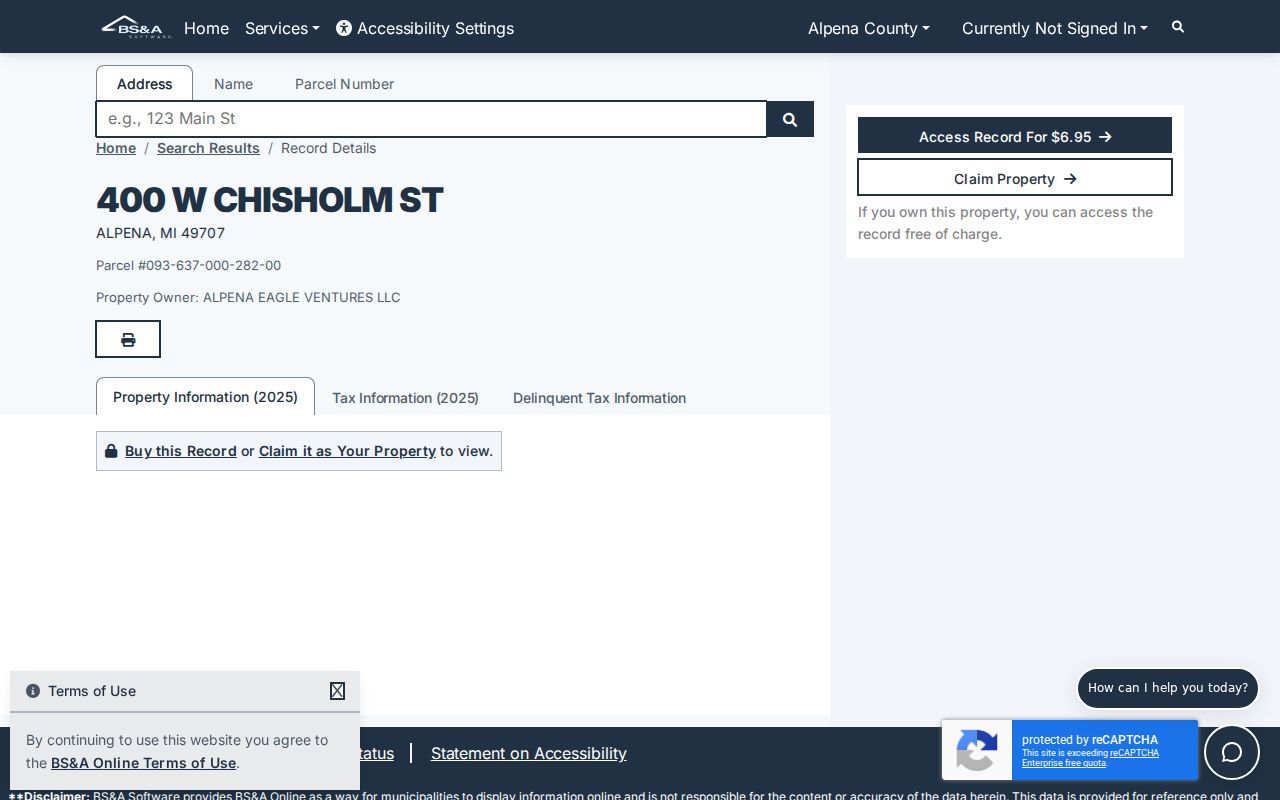
That screen separates the preview from deeper detail. Save the visible year and access terms with any number you copy.
Look Up Alpena County Tax
Start with the parcel number whenever you can. It beats an owner name for Alpena County property tax, since names vary and mailing addresses can differ from the property address. The parcel number has limits too. It is administrative, and it can change after a split or combination. Keep the situs address and municipality beside it.
- Open the county BS&A landing page and choose Current Tax Search for a current account or Delinquent Tax Search for a past-due account.
- Search by the full hyphenated parcel number. If it fails, try the normalized street address and confirm the municipality.
- Record the tax year, assessed value, SEV, taxable value, payment status, and source date exactly as displayed.
- For delinquency, follow the Treasurer's official page and check the foreclosure timeline, hardship materials, or payment link that fits the account.
- Assessed value
- The local assessor's value, generally 50 percent of true cash value before equalization.
- Millage or levy
- The rate applied to taxable value to produce a tax charge.
- Principal residence exemption
- A Michigan tax status that can affect parts of the levy; it is not a market-value discount.
- Tax lien
- A legal claim arising from unpaid tax, distinct from a mortgage or deed.
Payment is not research. A Pay Bill tile works fine for a transaction. The tax and assessment views preserve the year and basis needed to interpret Alpena County property tax records.
Alpena County Delinquent Property Tax
Delinquent real-property tax changes custodians in Alpena County. The County Treasurer takes over at that point. The office runs March settlement, reversion, and the delinquent tax revolving fund. Its delinquent property tax page ties the tax search to the foreclosure timeline, hardship materials, the public land auction, and a notice about interests in foreclosure-sale proceeds. That page is the office's main contact point.
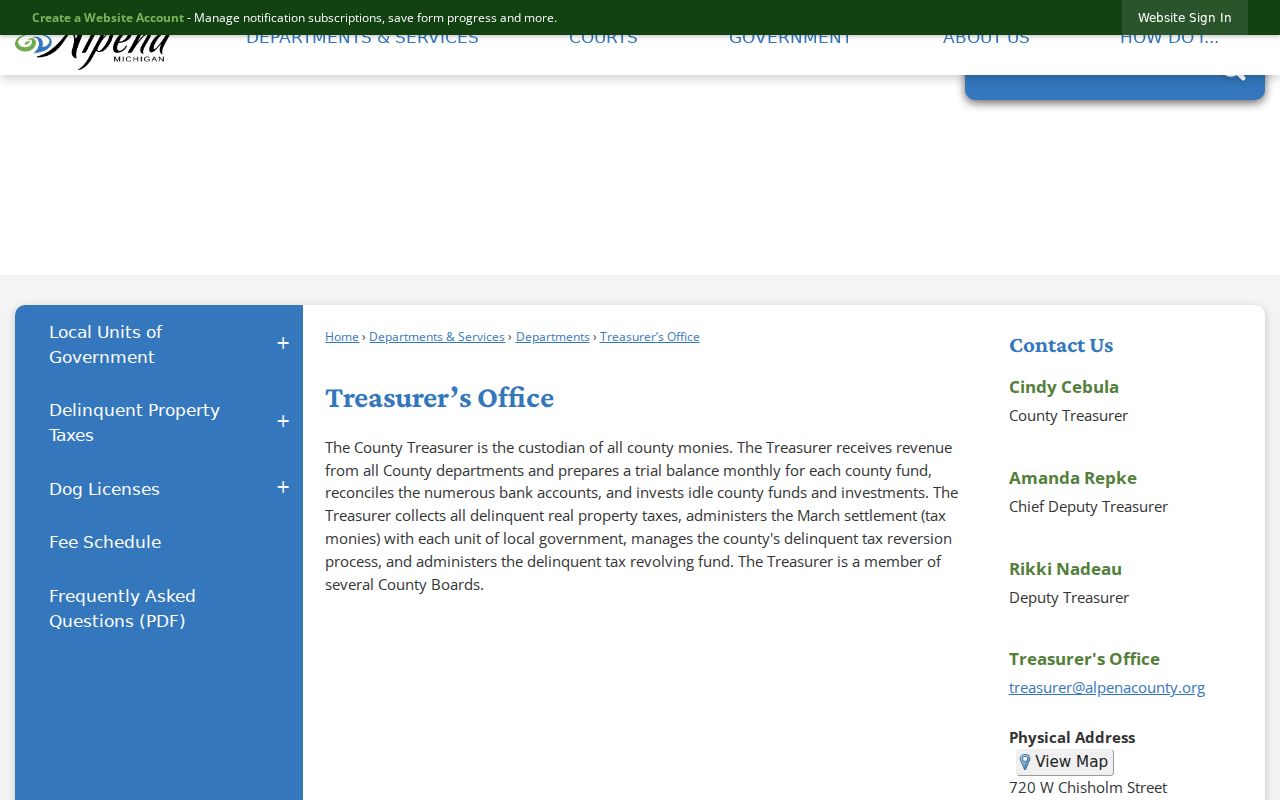
This path concerns delinquency and collection, nothing else. The Treasurer is not the deed recorder. A payment screen does not settle title. Never infer foreclosure from one unpaid line; record the year and status, then inspect the current timeline and notices. Administrative tax foreclosure can produce deeds or court-connected records, so match any consequential result to the parcel identifier and source date.
Transfers Change Alpena Taxable Value
Michigan caps taxable value at the lesser of five percent or the inflation rate. A transfer of ownership breaks the cap. Taxable value then uncaps to SEV the next year, subject to statutory details. The cap break drives the next owner's bill. A long-time owner's Alpena County property tax says little about it.
Four dated items deserve comparison. The deed transfer date comes first. The following assessment year comes next. That year's SEV matters. The taxable-value reset matters too. The Register of Deeds records the transfer instrument. The assessment and tax systems show its later tax effect. Agricultural property can receive different treatment, so resist forcing it into a residential example. The Michigan property-tax overview supplies the controlling framework.
Note: A recorded sale price, assessed value, and taxable value answer three different questions and keep their own dates.
Alpena County Tax Data Tiers
One parcel and a full tax-roll export are different products. The 2025 Alpena County fee schedule prices a county tax-roll export at $2,500. Countywide electronic assessment data costs the same. Township data runs $250 per township. Those prices attach to bulk data products, not to a single public parcel lookup.
Anyone needing many records should ask Equalization for specifics. Spell out the product, tax year, fields, delivery format, and municipal scope. For a single parcel, start with BS&A. Then contact Equalization or the Treasurer if a field is missing. An existing administrative record may sit outside the database. In that case, Alpena County FOIA accepts requests by mail, fax, email, or hand delivery. Name the parcel, years, record type, and responsible office. The county normally answers within five business days. Or it issues a written extension of up to ten more business days.
FOIA reaches existing records only. It cannot order a new tax history calculation. A precise request should name several items. List the assessment card, tax-roll entries, parcel number, municipality, and calendar years. Under county procedure, email and fax requests count as received one business day later. Inspection happens during normal hours. It is subject to lawful exemptions and allowable charges for search, review, redaction, copying, and delivery. Keep copies of the request and response alongside the resulting Alpena County property tax records.
Check Alpena Assessment Details
An April 2026 local-news report described an Equalization discussion. An assessor reportedly warned that some land-parcel assessments might omit additions or barns. Countywide equalized and taxable value shifts were also cited. It was not an official county data release. Treat it as a reason to verify, not as proof that a specific parcel is wrong.
Compare the BS&A property description and improvement fields against permit records, sale information, and other dated evidence. An aerial can reveal a structure. It cannot establish the structure's value or status. Send a correction question to the local assessor or the Equalization Office, and preserve the reply. This timely check helps most when Alpena County property tax records do not match known improvements.
Data check. Treat a mismatch as a question for the assessor, not proof that the tax record is inaccurate.
Contest an Alpena County Assessment
Michigan's local Board of Review is the usual first stop for assessment and classification disputes. The state supplies the L-4035 Petition to Board of Review, the L-4400 assessment notice, an L-4035a worksheet, and July and December review materials. Check the current year's calendar for your Alpena municipality. Filing deadlines vary each year. Dates from an older bulletin should not be carried forward as current.
Gather the notice, parcel card, photographs, measured building facts, comparable sales, and any evidence of a classification or exemption error. Keep assessed value, SEV, and taxable value distinct. Local review may still fail. When it does, the Michigan Tax Tribunal offers Small Claims and Entire Tribunal tracks for covered valuation, classification, principal-residence, agricultural, disability-veteran, poverty, and exemption disputes. It is not a deed or title forum.
Protect the appeal window. Confirm the current local Board of Review calendar before relying on any date, then file the proper petition with supporting evidence.
Need help spotting the right local assessor or decoding a taxable-value field on your notice? Alpena County Equalization can walk you through it. Call 989-354-9560 during its listed weekday office hours. The state tribunal is a later step, and only once its jurisdiction and filing rules apply.