
Compare Alpena County Property Values
Michigan attaches more than one value to every parcel. An Alpena County property value check works only when those labels stay separate. Assessed value, state equalized value, and taxable value each answer a different question. Note the tax year and the source whenever you copy a number down.
| Value | What It Is | Where |
|---|---|---|
| True cash value | The state's fair-market or usual-selling-price concept | State framework and local assessment work |
| Assessed value | Generally 50% of true cash value | Assessor and BS&A |
| State Equalized Value | The equalized assessed value, also generally 50% of true cash value | Assessment roll |
| Taxable value | The capped base used in the tax calculation | Assessment and tax record |
| Last sale price | Consideration from a particular transaction | Deed or sales record |
Proposal A caps annual taxable-value growth under Michigan law. A transfer generally uncaps that limit. Taxable value resets to the parcel's SEV the following year. Two similar parcels can therefore carry very different taxable values. Agricultural property follows special rules and should not be squeezed into a residential example.
Read Alpena County Record Years
One county BS&A display pairs 2025 property information with 2024 tax information. That split matters. Record the exact year beside every value you copy. Assessed value, SEV, taxable value, sale price, and owner display all need it. Two unlabeled numbers from different cycles should never be compared directly. The Alpena County BS&A portal splits its searches into categories. Assessing, property-sale, current-tax, delinquent-tax, and detailed-record each get their own layer. The assessment and sales layers carry the value meaning. Tax-bill mechanics belong to a separate tax-record workflow. The official BS&A property-details preview shows the parcel context and access notice around a value lookup.
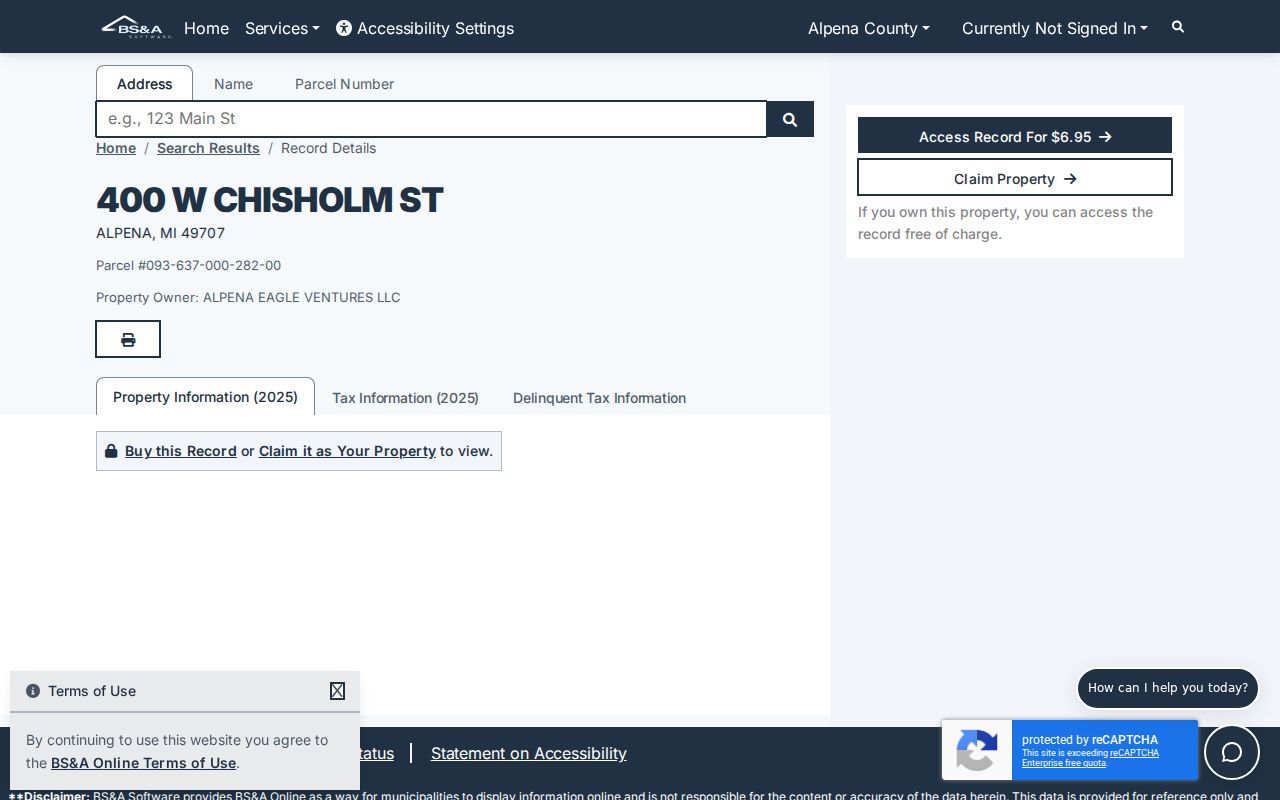
The preview opens the door to the parcel record. It is not a standalone appraisal, so read its year labels and value fields before matching them against any sale.
Transfers Can Reset Taxable Value
A Michigan ownership transfer generally uncaps taxable value to SEV in the next year, subject to statutory details. Line up the recorded transfer date, the next assessment year, SEV, and taxable value. A transfer-tax receipt or exemption notation describes the recording transaction. It does not settle market value or title history. Before a transfer, annual taxable-value growth is capped at the lesser of five percent or the inflation rate under Michigan's statutory rules. The cap governs taxable value only. It says nothing about sale price or market movement. After an uncapping event, the relationship among assessed value, SEV, and taxable value can shift sharply from the seller's record. Keep both years in view before concluding anything. The Register of Deeds collects Michigan Transfer Tax where it applies and requires tax certification for specified warranty deeds, land contracts, and assignments. Read the actual deed and the assessment record first. An exemption notation can explain a missing transfer-tax amount. Even so, it never determines the parcel's true cash value.
Alpena County Sale Price Context
A sale price records one bargain under its own conditions. It can test an assessment. But it is not automatically true cash value for every later year. Confirm the parcel, legal description, transaction date, and parties. Also note whether the sale was exposed to the open market. Entity transfers, family transactions, estate instruments, and land contracts may need extra context. Splits and combined parcels may need it too. A transfer-tax notation never substitutes for the deed. When BS&A displays a sale, match its date. Match its parcel to the recorded instrument rather than assuming the transfer covered the same land shown now. Build a comparison card with separate rows: sale price and date, assessed value and year, SEV and year, and taxable value and year. Add the owner display and parcel number. Label which facts came from BS&A, which from a deed, and which are state definitions. The card exposes mixed-year comparisons. It also keeps one attention-grabbing price from crowding out the rest of the evidence.
Alpena Assessment Data Warning
An April 2026 Alpena News report described an Equalization discussion. During it, an assessor warned that some land-parcel assessments might omit additions or barns. The article also reported county equalized-value growth of 9.2% and taxable-value growth of 5.14%. It was journalism, not a county data release. Treat it as a prompt to check, not a verdict on any parcel. Compare BS&A property characteristics, improvement detail, sales history, permits, and available aerial evidence. If something mismatches, ask the assessor or Equalization to explain or correct it. A May 2024 report offered older trend context. It cited SEV growth of nearly 15% and taxable home-value growth of nearly 7%. Do not merge those percentages with the 2026 figures. They did not measure the same period, class, or base. Countywide change cannot predict one parcel's value. Keep the publication date and label the figure as reported trend.
Equalization Answers Value Questions
Alpena County Equalization builds the county equalization report. The office also fields questions about assessments, GIS, and taxable value. Reach the office at 720 W Chisholm Street, Suite 5. Call 989-354-9560, or email equalizationoffice@alpenacounty.org.
Ask for the parcel's classification, assessed year, SEV, taxable value, and transfer treatment. Also ask the route for correcting data. Keep the answer with the source date and parcel number. The office's 2025 fee schedule separates ordinary questions from bulk products. County tax-roll and electronic assessment exports are listed at $2,500 each. Those export prices say nothing about the cost of viewing a single parcel.
Estimate Alpena County Record Value
A careful value lookup keeps each label distinct instead of melting every figure into a single estimate.
- Search BS&A by address or parcel number and confirm the municipality.
- Copy assessed value, SEV, taxable value, and each displayed year.
- Check the sales record and recorded deed for price and transfer date.
- Note exemptions, classification, transfer, split, or merge clues.
- Ask the assessor or Equalization about an unexplained difference.
- Assessed value
- The local assessment figure, generally half of true cash value in Michigan.
- True cash value
- The state's fair-market or usual-selling-price concept.
- Assessment ratio
- The relationship between assessed value and true cash value.
- Reassessment
- A new determination for a later assessment cycle.
- Consideration price
- The amount stated for a particular transfer.
Request Missing Alpena Value Records
Going online is only one channel. Equalization also answers questions by phone, email, and at the counter. Records that never appear online still exist.
You can request them under Michigan FOIA. Submit by mail, fax, email, or hand delivery to Alpena County, describing the parcel, the year, and the record type from the office that holds it. The county then generally responds within five business days, or it issues a written extension adding up to ten more. FOIA opens the door to an existing assessment card or roll entry, but it cannot force the county to produce a new appraisal or settle a valuation question.
Taxable Is Not Market Value
Taxable value serves the property-tax math. It can stay capped while ownership stays the same. Assessed value and SEV follow Michigan's assessment framework instead, and a last sale price describes one transaction on one date. Each label answers a different question.
Exemptions complicate the picture further. Principal-residence, disabled-veteran, poverty, agricultural, and other exemptions can shift the taxable result without changing what the property would fetch on the open market. Classification matters too. Preserve the exact exemption or class shown, then ask the assessor what it means for that parcel. Never subtract an exemption from a sale price or treat a tax cut as an appraisal adjustment.
When the real goal is a tax bill, an exemption, or an appeal deadline, use the Alpena County property tax records process instead. A value interpretation should stop short of promising any tax outcome.
Limit Alpena County Value Claims
An assessment exists for public tax administration. It can rest on parcel data that needs correcting. It can also follow a year that differs from a sale, and land far from a buyer's actual price. A licensed appraisal studies the property for one effective date and one stated purpose. No automated estimate and no single nearby sale can substitute for that work.
Value versus price. An Alpena County assessed value is for taxation and is not a promise of sale price. It is not a private appraisal.